Geopolitics and the Quest for Dominance by Jeremy Black
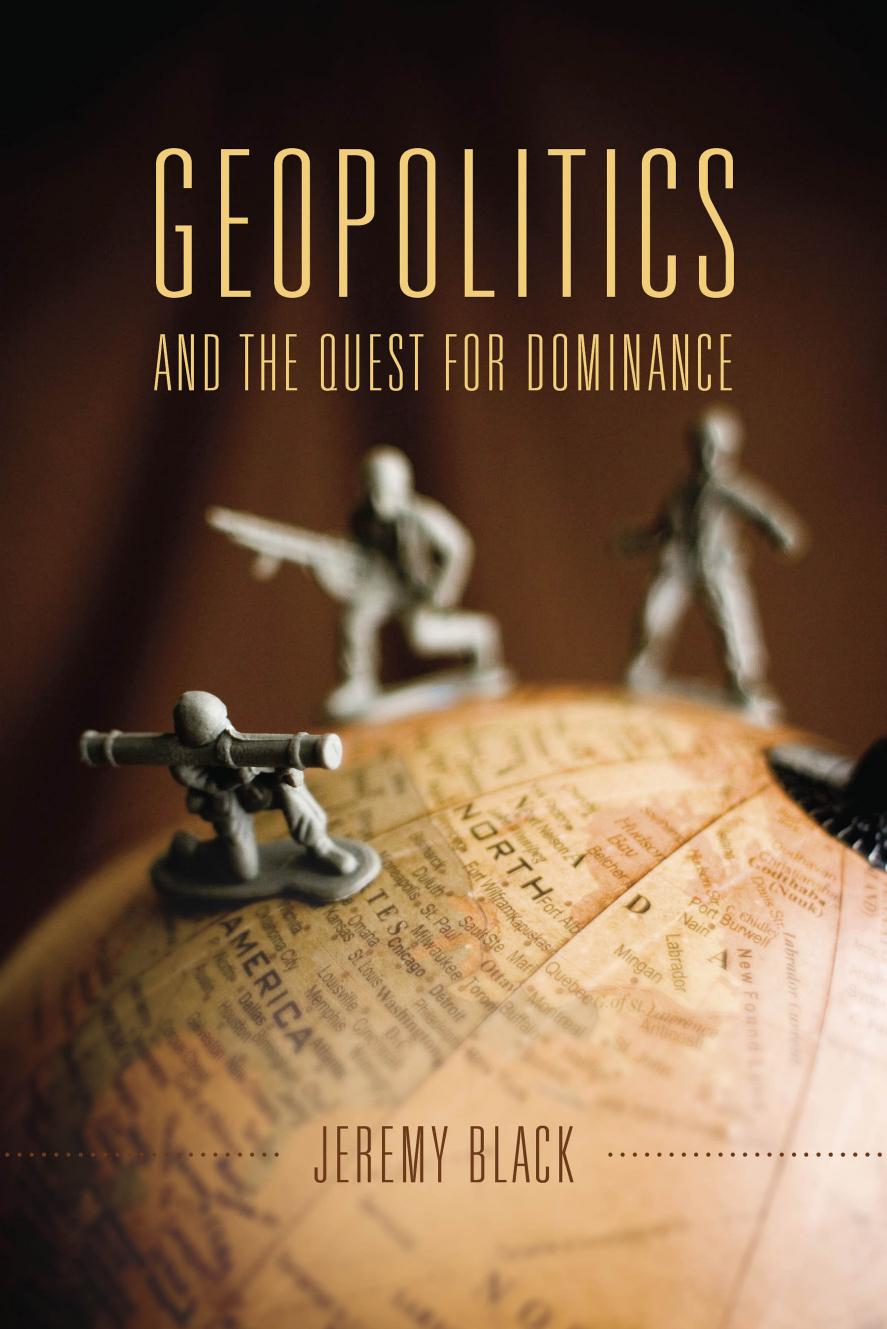
Author:Jeremy Black [Black, Jeremy]
Language: eng
Format: epub, pdf
ISBN: 9780253018731
Google: H3jjCgAAQBAJ
Published: 2015-11-25T05:46:01+00:00
THE MIDDLE EAST
The geopolitical narrative for the twentieth century at the global level is reasonably clear, but it overlapped and interacted with different and distinct narratives, notably, but not only, at the regional level. An important one, which had deep historical roots and continues to the present, occurred in the Middle East. The history and present of the Middle East involves a dichotomy of order and disorder. The quest for order is in part scriptural, religious, cultural and social, but is also a matter of attempts to create political spaces where these orders can be pursued and where disorder can be held at bay.
This issue was contained within imperial structures prior to the twentieth century, although these structures faced serious problems from across borders. The Wahhabis of Arabia were a prominent example in the early nineteenth century. There were also challenges from within empires, as with autonomous movements in Egypt repeatedly challenging the Ottoman Empire, and from competing empires. Prior to the second half of the eighteenth century, when Russian expansion became a serious issue, the major challenge came from other Islamic empires and movements, for example, the Ottoman overthrow of the Mamluks of Egypt and Syria in 1516â1517 or Nadir Shah of Persiaâs pressure on the Ottomans in the 1730s to the 1740s. European expansion was different, ultimately, not only because it was successful in the nineteenth and early twentieth centuries, but also because it seriously challenged existing Islamic assumptions of order. In response, the Ottomans had periodic movements for renewal. In Palestine, Lebanon, and Syria, the challenge to the Islamic world from Western expansion was linked to sectarian tensions relating to Jews, Christians and Druze. As a result of this response, the new imperial structures created after World War I did not work well and had to be maintained by force: in Syria, by the French in the 1920s and, in Palestine, by the British in the 1930s.
In the postimperial period in the Middle East after World War II, this process of challenge and response was repeated, but in a different geopolitical context. Moreover, the ability to devise stable domestic political solutions was made more complicated as a result of nearby hostile neighbors. Thus, whether the route pursued was control or compromise over territory, as in Israel and Lebanon, respectively, the situation was inherently difficult.
The geopolitical context ensured the pressures of terrain, climate and logistics on the implementation of strategy.60 This context also changed in a number of respects, including that of the means by which territory was represented. In a crowded world employing precise means of measurement in order to define and represent boundaries, it is understandable that the past was, and is, scrutinized to provide historical credence for such frontiers. However, for most of human history, major empires had, instead of clear lines, zones of authority in their border areas, zones in which the pretensions of imperial power did not always match the situation on the ground. And so for the Ottoman Empire, which overthrew its
Download
Geopolitics and the Quest for Dominance by Jeremy Black.pdf
This site does not store any files on its server. We only index and link to content provided by other sites. Please contact the content providers to delete copyright contents if any and email us, we'll remove relevant links or contents immediately.
| Anthropology | Archaeology |
| Philosophy | Politics & Government |
| Social Sciences | Sociology |
| Women's Studies |
Born to Run: by Christopher McDougall(7127)
The Leavers by Lisa Ko(6948)
iGen by Jean M. Twenge(5415)
Sapiens by Yuval Noah Harari(5370)
Spare by Prince Harry The Duke of Sussex(5197)
The Kite Runner by Khaled Hosseini(5179)
Machine Learning at Scale with H2O by Gregory Keys | David Whiting(4313)
Bullshit Jobs by David Graeber(4190)
Never by Ken Follett(3956)
Goodbye Paradise(3810)
Livewired by David Eagleman(3772)
Fairy Tale by Stephen King(3396)
A Dictionary of Sociology by Unknown(3085)
Harry Potter 4 - Harry Potter and The Goblet of Fire by J.K.Rowling(3073)
The Social Psychology of Inequality by Unknown(3031)
The Club by A.L. Brooks(2925)
Will by Will Smith(2919)
0041152001443424520 .pdf by Unknown(2845)
People of the Earth: An Introduction to World Prehistory by Dr. Brian Fagan & Nadia Durrani(2736)
